
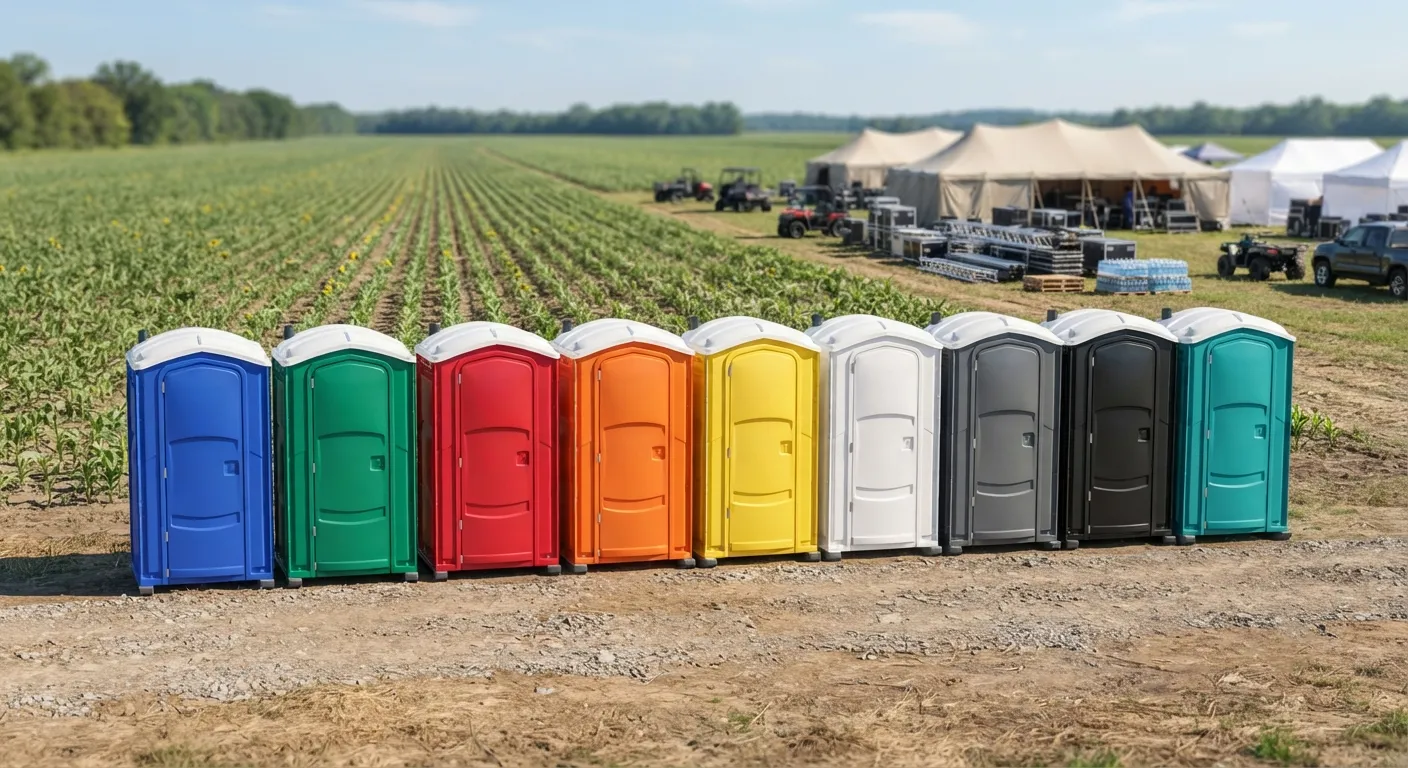
What Do Farms and Ranches Actually Need for Restrooms?
Hand-labor crews picking, pruning, or sorting fall under OSHA 1928.110, which is written specifically for agriculture. It requires potable water, toilet facilities, and handwashing access, and it caps the walk at a quarter mile from any work station. That is a different rule than the construction standard, OSHA 1926.51(c), which sets one toilet per 20 workers on a job site. If your operation runs both field labor and a construction crew building a new barn or irrigation structure, you may need to plan for both ratios at once. Check the OSHA portable toilet requirements page for how the counts differ, or use how many porta potties do I need to work out crew size against acreage.
Most ranches and farms around Saint George run standard porta potty rental units, each with a 60 to 70 gallon holding tank and a footprint of about 44 by 48 inches on the ground. That is small enough to tuck at a field edge, a barn corner, or a staging area without blocking equipment. Larger crews or longer harvest seasons often add a handwashing station rental or a portable sink rental next to the toilets, since 29 CFR 1910.141(d)(2) requires soap and towels or a hand-drying device, and hand sanitizer alone does not satisfy that standard.
How Often Do Units Get Serviced During Harvest?
Weekly service is the baseline for portable sanitation under ANSI/PSAI Z4.3, which sets one visit per week for up to 10 users across a 40 hour week. Harvest crews often exceed that use rate, so a lot of our ag customers move to twice-weekly pumping during peak weeks, then drop back to standard weekly service in the slow months. If your crew count changes with the season, a monthly porta potty rental with adjustable service frequency usually works out cheaper than juggling short-term rentals every few weeks. Check the monthly porta potty rental page for how that pricing breaks down against day and week rates.
Dairy operations and larger ranches sometimes need a holding tank instead of, or alongside, standard units, particularly where wash water or runoff has to be managed apart from the septic system. Our holding tank rental page covers that setup. If the farm already runs a septic system for a farmhouse or bunkhouse, a residential tank is typically pumped every 3 to 5 years depending on tank size and household size, and our septic pumping service team handles that on the same route as your restroom service, so you are not scheduling two separate visits.
| unit | duration | typical price |
|---|---|---|
| standard | day | $150 |
| standard | week | $200 |
| standard | month | $200 |
| deluxe | week | $250 |
Where Should Units Go on a Working Farm?
Placement matters more on a farm than almost anywhere else we deliver, because tractors, trucks, and irrigation lines need clear paths, and a unit set in the wrong spot gets run over by August. Stable, firm, slip-resistant ground is the standard we hold every placement to, echoing ADA Standards 302.1, even where a formal accessible unit is not required. If a farm stand, u-pick event, or agritourism day brings in the public, at least one accessible unit is worth having on site: ADA Standards 213.2 calls for 5 percent of a cluster of single-user toilets to be accessible, with a minimum of one, so check our ADA accessible porta potty page before a public event weekend.
Delivery trucks need room to maneuver on unpaved field roads and around barns, same as any roll-off dumpster rental delivery, which needs about 60 feet of straight clearance behind the truck. Give us that clearance and a call ahead of harvest, and we will route the unit to wherever your crew actually works, not just the gate. Farms near Hurricane, 18.1 miles east of Saint George, and Dammeron Valley, 17.7 miles north, are both inside our regular delivery loop, same as ranches closer in around Ivins, 10.2 miles northwest. For farms clearing land or renovating outbuildings, pair your restroom order with a construction dumpster rental or check what cannot go in a dumpster before loading it with chemical containers or tires.
How many restrooms does a 20 person picking crew need?
Under OSHA 1928.110, one facility per 20 workers is the baseline, so a 20 person crew needs at least one toilet and one water source within a quarter mile walk. Spread across multiple fields, add a unit per cluster.
Can we get service during winter for year-round ranch work?
Yes. Freeze protection and adjusted service schedules keep units working through cold stretches. See porta potty in winter for how we handle that around Saint George.
Do you deliver to farms outside Saint George city limits?
Yes, our delivery loop covers Washington, Santa Clara, Ivins, Hurricane, and Dammeron Valley. Check service areas for driving distances from your property.
What is the difference between a holding tank and a standard unit?
A holding tank handles wash water and runoff separately from toilet waste, useful for dairies and wash stations. Standard units are self-contained with a 60 to 70 gallon tank for toilet use only.
How do we get a quote for a full harvest season?
Call or submit a request a quote with your crew size and acreage. We will build a weekly or monthly schedule around your harvest calendar.
Next step
Get a delivery date
Tell us the address, the dates and the headcount. We size the order and confirm the route.